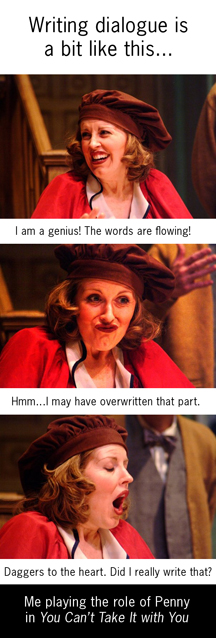
I have begun the highly anticipated process of revising my novel. After two years of drafting, being to this point is super exciting...and daunting for me. The truth is, I revised my novel...a lot...before I finished it. I threw out the first six months of work and started over again. I also nitpicked the NEW first third to death (like a year) before moving onto the last two-thirds of my novel, which I wrote in two months. Suffice it to say, it took me a long time to get where I'm at now.
I used to think things like, "Huh, my chapter turned out so much better than I thought it would. Lucky me. If I hadn't decided to write when I did on this particular day and time, and under these exact circumstances, this unique chapter couldn't have been written." In retrospect, I see I was crediting each success along the way to things beyond me. Because things like, I don't know, hard work and determination couldn't possibly have produced a good chapter. I did work hard. I busted my butt. But that couldn't be the reason why my chapters magically came together.
I remember reading interviews of published authors who said they threw out their WHOLE novels and started over again...sometimes more than once. That idea terrified me. I mean, I was fortunate in the first place to have produced a decent chapter, right? How could I toss it out, hoping luck would find me again? The odds weren't good.
I've been under the silly notion that cutting down my lengthy novel to the appropriate size would be a simple matter of hitting the delete key 40,000 times.
Ha!
I just wrote a new chapter one. At least half of it was new material (that was the part I'd been dreading, but was actually fun); the other half was a maddening puzzle-piecing together of stuff I'd already written. When I finished, I'd reduced three long chapters to ten pages. And guess what? The new chapter is SO MUCH BETTER than what I'd written before.
I realized something: maybe, just maybe, this could do with a little person called me. Maybe I was a talented enough to make something shiny and new all over again--every time I determined to. It didn't have to be during a magical time of day or because the planets had aligned.
Now I'm not trying to diss that inspiration plays a big part in writing. We all have our muses and tricks to help set the mood. And I do credit my crit partners, my husband, and other readers for feedback that's helped me shape my story. But I finally realized I can rewrite something well...and take a little credit.
Mary Kole said on her website a few weeks ago, "Words are a renewable resource." That resonated with me, but also had me shaking in my boots. Was I capable of writing better than I had in the first place?
Yes I was. Yes I am.
Sunday, February 26, 2012
Sunday, February 19, 2012
Love Triangle Agony
So most my crit partners have now read The Rowaness of Shalott. I read it myself after two months' distance (and before reading their critiques). Most of their comments were in line with things I also saw when I read, but the biggest shocker came from one of my best friends (also a crit partner).
She hates Lancelot.
WHAT?!!! How could she hate Lancelot? Impossible!
The feedback I've gotten from other readers/crit partners so far is that they love both Lancelot and Arthur, which is what I wanted. I love them equally, though I know who Guinevere will end up with at the end of my trilogy. I've written both men very differently. Arthur is perfect (which ends up being a flaw) and Lancelot isn't (which compels me to him). I naively thought that every reader would follow Guinevere's story and fall in love with each man when she did.
I was very, very wrong.
This is the joy of love triangles, and after a weekend of being very hurt and angry, I've realized a few things, talked to several people, and come away with some insights.
Guess what? When you write a love triangle, you inadvertently ask your readers to love one interest more than the other. To what degree they love the one, they often hate the other in an equal measure.
Let's take Twilight, for example. I hate Jacob. Hate him. But I suddenly like him during the second half of Breaking Dawn. I realized this was because he was no longer a threat to Bella and Edward's relationship. I could give you paragraphs of valid reasons why I hated Jacob before, but fundamentally, it came down to fact that he was not Edward and was standing in the way of him.
There are some books, however, that I like both love interests (though I still have a favorite). Unearthly and Matched come to mind. But anytime I truly, madly, deeply fall in love with a love interest, I HATE the rival.
Cassandra Clare says your readers should be split down the middle with which love interest they prefer in a love triangle. The stronger they hate and love the other is a GOOD SIGN your story is working.
Now I'll admit love triangles annoy me to no end when they're the typical both-boys-fighting-over-the-girl-and-oh-dear-who-will-she-choose variety. You start hating the girl for being wishy-washy, bouncing back and forth between them. But love triangles can be very effective story tools. Cassandra Clare says if the two boys have a solid friendship, that makes things more interesting (Arthur and Lancelot are best friends, so check). It also makes things more interesting (according to me) if both boys AREN'T fighting for the girl. If they're confused whether they love her or not in the first place. All right, that's all I'm going to spill about my story. The point is, love triangles do have their place in literature AND can be very compelling.
One of the panels I attended at LTUE was on fractured fairy tales. The authors agreed that the reason they fracture a fairy tale is usually because they hated the original or something about it. This is true for me with the Arthurian legends. I dislike how the love triangle is often handled between Arthur, Guinevere and Lancelot. And so The Rowaness of Shalott was born.
I've realized that as I writer I need to let my book communicate in whatever way it will for my readers. I can write, revise and polish all I want, but in the end, not everyone's going to like my story or all of my characters. This friend who hated Lancelot, loved two other characters who none of my other readers have liked so far. Is she right or wrong? It doesn't matter. She is having her own valid experience with my book, and she should be allowed that. Every reader should be. It breaks my heart that she hates Lancelot because I know I won't change him (and because I wanted this close friend to enjoy him). But for my purposes as a writer, he is everything I want him to be. (But my friend loves Arthur. So that's something to be happy about.)
Little did I know what I was getting myself into with writing this love triangle. But now I've gotten a taste for what to expect, I'm more prepared.
*skips away to make Team Lancelot and Team Arthur t-shirts*
For more thoughts on love triangles, visit my awesome crit partner's blog post. (For the record, Ilima loved both Arthur and Lancelot.)
Also, a shout out goes to another crit partner, Taryn, who just signed with agent Vickie Motter. Taryn is a mad genius and we all live vicariously through her. Congrats, Taryn! (Time will tell if she likes Arthur and Lancelot. I'll send her the second draft of Rowaness...hopefully minus 40,000 words.)
She hates Lancelot.
WHAT?!!! How could she hate Lancelot? Impossible!
The feedback I've gotten from other readers/crit partners so far is that they love both Lancelot and Arthur, which is what I wanted. I love them equally, though I know who Guinevere will end up with at the end of my trilogy. I've written both men very differently. Arthur is perfect (which ends up being a flaw) and Lancelot isn't (which compels me to him). I naively thought that every reader would follow Guinevere's story and fall in love with each man when she did.
I was very, very wrong.
This is the joy of love triangles, and after a weekend of being very hurt and angry, I've realized a few things, talked to several people, and come away with some insights.
Guess what? When you write a love triangle, you inadvertently ask your readers to love one interest more than the other. To what degree they love the one, they often hate the other in an equal measure.
Let's take Twilight, for example. I hate Jacob. Hate him. But I suddenly like him during the second half of Breaking Dawn. I realized this was because he was no longer a threat to Bella and Edward's relationship. I could give you paragraphs of valid reasons why I hated Jacob before, but fundamentally, it came down to fact that he was not Edward and was standing in the way of him.
There are some books, however, that I like both love interests (though I still have a favorite). Unearthly and Matched come to mind. But anytime I truly, madly, deeply fall in love with a love interest, I HATE the rival.
Cassandra Clare says your readers should be split down the middle with which love interest they prefer in a love triangle. The stronger they hate and love the other is a GOOD SIGN your story is working.
Now I'll admit love triangles annoy me to no end when they're the typical both-boys-fighting-over-the-girl-and-oh-dear-who-will-she-choose variety. You start hating the girl for being wishy-washy, bouncing back and forth between them. But love triangles can be very effective story tools. Cassandra Clare says if the two boys have a solid friendship, that makes things more interesting (Arthur and Lancelot are best friends, so check). It also makes things more interesting (according to me) if both boys AREN'T fighting for the girl. If they're confused whether they love her or not in the first place. All right, that's all I'm going to spill about my story. The point is, love triangles do have their place in literature AND can be very compelling.
One of the panels I attended at LTUE was on fractured fairy tales. The authors agreed that the reason they fracture a fairy tale is usually because they hated the original or something about it. This is true for me with the Arthurian legends. I dislike how the love triangle is often handled between Arthur, Guinevere and Lancelot. And so The Rowaness of Shalott was born.
I've realized that as I writer I need to let my book communicate in whatever way it will for my readers. I can write, revise and polish all I want, but in the end, not everyone's going to like my story or all of my characters. This friend who hated Lancelot, loved two other characters who none of my other readers have liked so far. Is she right or wrong? It doesn't matter. She is having her own valid experience with my book, and she should be allowed that. Every reader should be. It breaks my heart that she hates Lancelot because I know I won't change him (and because I wanted this close friend to enjoy him). But for my purposes as a writer, he is everything I want him to be. (But my friend loves Arthur. So that's something to be happy about.)
Little did I know what I was getting myself into with writing this love triangle. But now I've gotten a taste for what to expect, I'm more prepared.
*skips away to make Team Lancelot and Team Arthur t-shirts*
For more thoughts on love triangles, visit my awesome crit partner's blog post. (For the record, Ilima loved both Arthur and Lancelot.)
Also, a shout out goes to another crit partner, Taryn, who just signed with agent Vickie Motter. Taryn is a mad genius and we all live vicariously through her. Congrats, Taryn! (Time will tell if she likes Arthur and Lancelot. I'll send her the second draft of Rowaness...hopefully minus 40,000 words.)
Friday, February 3, 2012
Let's Talk Dialogue
Dialogue is a powerful tool in writing. It effortlessly shows rather than tells, it's more often than not used "in-scene," and it usually improves pacing. BUT writing dialogue and all its mechanics is a tricky business. Agents often skip to dialogue-heavy sections of novels they're considering because dialogue reveals the skills of a writer instantaneously.
The times I'm most engaged as a writer is when I'm writing dialogue.I write slowly by nature, but with dialogue, I can't write fast enough! I usually skip the dialogue tags and action beats between the lines, just trying to stay on top of the words my characters are spewing back and forth to each other. I often know what they say in the middle or at the end of a conversation, and I bounce back and forth trying to capture everything. Once I finally get their words out, I go back and plug in the necessary tags and beats.
While I don't pretend to be the know-it-all master of dialogue, I can tell you some of my tried-and-true tricks.
I'd say good dialogue comes down to two rules: it needs to sound natural and it needs to be compact for the purposes of tight fiction (which is not how people speak in real life). The two rules oppose each other, and it's the writers job to strike the right balance.
Natural Dialogue
When I was little girl, my siblings and I would record our voices onto audio cassette tapes. Then in my early teens my dad bought a video camera. So in some format or another, I was constantly recording improvisational scenes. If you haven't tried improv acting before, I'd highly recommend it. Even if you'd rather be an observer, you can attend local improv comedy troupe shows and LISTEN, LISTEN, LISTEN to the dialogue that comes naturally and on-the-spot from these actors. (Listening to real conversational speech is beneficial as well, but be careful because "real people" don't speak compactly...more on that later.)
In high school I began acting in plays and did so throughout college and beyond. Because plays are 95% dialogue, I was forced to analyze, line by line, scene by scene, what I was required to say and how to make it work. I had to find the objective, motivation and tactics for my character. I had to know what I was really saying between the lines. And there was nothing worse than trying to act well while delivering a badly written line. I constantly considered whether dialogue (especially written by amateur playwrights) was something my character would really say--if it sounded believable, natural.
Then throughout high school I wrote in volumes upon volumes of journals. My average was ten pages a day, and on really good days, I would write up to fifty pages (and these were large-paged journals, not tiny pocket-sized ones). I wasn't thinking dialogue, dialogue, dialogue as I wrote these entries, but that's what they mostly were comprised of. Somehow I recalled conversations from the day, and I recorded them in my journal, not in a summarizing fashion, but moment for moment, word for word--"in-scene." I would skip to the part of the conversation that got interesting and start there (and I'd stop writing before the conversation got dull again). Which brings us to the next point in writing good dialogue:
Compressed Dialogue
It would sound natural (but would be painstakingly boring) if we wrote dialogue just as it is in real life. It would read like this:
"Hey."
"Hey."
"What's up?"
"Not much."
"Nice day."
"Yeah. Might rain later."
"Mmmm."
"So..."
"Yeah?"
This is small talk. Not much tension or conflict. The best dialogue--even between characters who like each other or are on the same side--must have conflict. So here is where we bend the law of natural dialogue to include only the most interesting parts, which again, must have conflict. I have to now go back to the dialogue I wrote where I let my characters endlessly banter and go off on tangents and trim it down to fit the purpose of the scene. And if my character felt the need to make some big speech (and you can only get away with so many of these), I need to liposuction that as well, and then break it up with beats, interiority, and reactions from the other character(s).
Check Your Dialogue
The most important thing you can do to test the quality of your dialogue is to read it aloud--or even better, have someone else read it aloud to you. Become actors and stage the scene you wrote. As you speak aloud, see where you or your friend stumble on the wording, or where your ears--and not your eyes--tell you something is wrong. Additionally, make sure your characters have different voices, patterns of speech, etc. And make sure the dialogue mechanics are helping, not hindering, the conversation of your characters. Get rid of dialogue tags when you can--but not all, as not to exhaust your reader. If you use beats in place of a dialogue tag, and in where it's otherwise unclear who is speaking, it's best to write the action beat before that character starts talking. For example:
"Are you going to tell me what happened last night?" Jane said.
Michael fiddled with his shoelaces, not meeting her eyes. "What's for dinner?"
The above example also works for misdirecting the conversation, which is another great dialogue tool. Rather than have your characters speak plainly back and forth to each other, it's nice when they try to change subjects, interrupt each other, trail off, beat around the bush, speak in fragmented sentences, and answer a question with a question. All these tactics add tension, conflict and believability to the scene.
Some other quick reminders:
The times I'm most engaged as a writer is when I'm writing dialogue.I write slowly by nature, but with dialogue, I can't write fast enough! I usually skip the dialogue tags and action beats between the lines, just trying to stay on top of the words my characters are spewing back and forth to each other. I often know what they say in the middle or at the end of a conversation, and I bounce back and forth trying to capture everything. Once I finally get their words out, I go back and plug in the necessary tags and beats.
While I don't pretend to be the know-it-all master of dialogue, I can tell you some of my tried-and-true tricks.
I'd say good dialogue comes down to two rules: it needs to sound natural and it needs to be compact for the purposes of tight fiction (which is not how people speak in real life). The two rules oppose each other, and it's the writers job to strike the right balance.
Natural Dialogue
When I was little girl, my siblings and I would record our voices onto audio cassette tapes. Then in my early teens my dad bought a video camera. So in some format or another, I was constantly recording improvisational scenes. If you haven't tried improv acting before, I'd highly recommend it. Even if you'd rather be an observer, you can attend local improv comedy troupe shows and LISTEN, LISTEN, LISTEN to the dialogue that comes naturally and on-the-spot from these actors. (Listening to real conversational speech is beneficial as well, but be careful because "real people" don't speak compactly...more on that later.)
In high school I began acting in plays and did so throughout college and beyond. Because plays are 95% dialogue, I was forced to analyze, line by line, scene by scene, what I was required to say and how to make it work. I had to find the objective, motivation and tactics for my character. I had to know what I was really saying between the lines. And there was nothing worse than trying to act well while delivering a badly written line. I constantly considered whether dialogue (especially written by amateur playwrights) was something my character would really say--if it sounded believable, natural.
Then throughout high school I wrote in volumes upon volumes of journals. My average was ten pages a day, and on really good days, I would write up to fifty pages (and these were large-paged journals, not tiny pocket-sized ones). I wasn't thinking dialogue, dialogue, dialogue as I wrote these entries, but that's what they mostly were comprised of. Somehow I recalled conversations from the day, and I recorded them in my journal, not in a summarizing fashion, but moment for moment, word for word--"in-scene." I would skip to the part of the conversation that got interesting and start there (and I'd stop writing before the conversation got dull again). Which brings us to the next point in writing good dialogue:
Compressed Dialogue
It would sound natural (but would be painstakingly boring) if we wrote dialogue just as it is in real life. It would read like this:
"Hey."
"Hey."
"What's up?"
"Not much."
"Nice day."
"Yeah. Might rain later."
"Mmmm."
"So..."
"Yeah?"
This is small talk. Not much tension or conflict. The best dialogue--even between characters who like each other or are on the same side--must have conflict. So here is where we bend the law of natural dialogue to include only the most interesting parts, which again, must have conflict. I have to now go back to the dialogue I wrote where I let my characters endlessly banter and go off on tangents and trim it down to fit the purpose of the scene. And if my character felt the need to make some big speech (and you can only get away with so many of these), I need to liposuction that as well, and then break it up with beats, interiority, and reactions from the other character(s).
Check Your Dialogue
The most important thing you can do to test the quality of your dialogue is to read it aloud--or even better, have someone else read it aloud to you. Become actors and stage the scene you wrote. As you speak aloud, see where you or your friend stumble on the wording, or where your ears--and not your eyes--tell you something is wrong. Additionally, make sure your characters have different voices, patterns of speech, etc. And make sure the dialogue mechanics are helping, not hindering, the conversation of your characters. Get rid of dialogue tags when you can--but not all, as not to exhaust your reader. If you use beats in place of a dialogue tag, and in where it's otherwise unclear who is speaking, it's best to write the action beat before that character starts talking. For example:
"Are you going to tell me what happened last night?" Jane said.
Michael fiddled with his shoelaces, not meeting her eyes. "What's for dinner?"
The above example also works for misdirecting the conversation, which is another great dialogue tool. Rather than have your characters speak plainly back and forth to each other, it's nice when they try to change subjects, interrupt each other, trail off, beat around the bush, speak in fragmented sentences, and answer a question with a question. All these tactics add tension, conflict and believability to the scene.
Some other quick reminders:
- Make sure your stick to "said" as much as possible in your dialogue tags.
- Don't use physical impossibilities for speaker attributions. (A character doesn't "laugh" or "grimace" a line of speech. They SAY it. So none of this: "Let's have a picnic," Teresa smiled.)
- Paragraph your dialogue (a new paragraph for each person speaking). For the most part, this rule applies for character reactions too. So if one character is speaking and the other character reacts rather than says anything back, place that reaction in a separate paragraph, as if it were a line of dialogue.
- Don't explain in your interiority or action beats what is apparent by the dialogue alone. Interiority is best used when it's revealing thoughts that are in opposition to the dialogue--or at least a completely different line of thought.
- Get rid of adverbs in dialogue tags (he said lovingly) unless they actually modify the verb "said" (quietly, softly and clearly are okay, if you really need them).
- Beware of melodrama in dialogue. Hopefully you can identify this by reading your dialogue aloud. Then make sure your scene isn't all at the same pitch; make sure it builds into a tense moment and there's contrast within the scene. Then compare all your scenes and make sure there is an arc to them--that they're not all at the same emotional intensity.
- Beware of exposition/back story in dialogue. This is okay, but only if it is something the characters would naturally say to each other, and not just a device for the author to divulge necessary information to the reader.
- Don't spell out dialects or accents in language. You CAN use language improperly or irregularly, though. (Like, "You don't got no business talking to me" if a character isn't well educated, or "Please to tell me what you mean" if a character is a foreigner.)
Friday, January 27, 2012
If You Really Knew Me...
Thanks to my friend Michelle for inspiring me with her own "If you really knew me" blog post.
If you really knew me, you'd know I cannot multitask. I've had selective hearing for as long as I can remember. It's so hard to fight against my body's instinct to keep me focused on one thing at a time.
If you really knew me, you'd know I cannot stand to see someone suffer. I'm still trying to learn that everything's not my fault and I cannot fix everything. Still, it hurts.
If you really knew me, you'd know that I laugh loudly. I throw my head back or double over or shake the chair I'm sitting in.
You'd know the thing that most often triggers my tears is a beautiful song.
You'd know I made a gazillion home movies growing up. Most featured myself as the princess or the glamorous movie star, while I made my younger sister play the maid or the moron.
If you really knew me, you'd know I used to cut off my lower eyelashes in my younger teens. They were too long and curly. I've since embraced my Twiggy eyelashes.
If you really knew me, you'd know that as a teen I was OBSESSED with U2, Winona Ryder, The Young Riders, and Greek mythology. I had scrapbooks for all of these things.
You'd know I have about 37,869 most embarrassing moments. Topping them all is the slo-mo "violin fart" in front of 50 girls and the ultimate trip down the stairs at my junior high school (I kept ricocheting into the wall as I endlessly rolled downward).
You'd know my left kidney belongs to my older brother now.
You'd know I play sad folk songs on my guitar. I don't know how many times my high school friends had to endure my rendition of "Blowin' in the Wind."
If you really knew me, you'd know I have nine brothers and sisters. I'm the oldest sister. That makes me the boss.
If you really knew me, you'd know I am a PERFECTIONIST. And it drives me crazy.
You'd know when my husband proposed to me, he gave me his glow-in-the-dark CTR ring to wear until he could afford something more.
You'd know I won first place in monologues at the statewide high school Shakespearean festival. I was so surprised I jumped on the old man presenting the award and gave him a hug. Luckily, he didn't topple over.
You'd know I cuss like a sailor when I snow ski, or any other time I think I might die.
You'd know that in high school my best friend and I made love potions and drank them--raw eggs and all.
If you really knew me, you'd know that the quality I most admire in others is their sincerity. Being fake is a cardinal sin in my book.
If you really knew me, you'd know I give my heart away easily. It gets trampled on often, but I'd still rather be this way.
If you write your own "If you really knew me" post, please let me know! I'd love to learn more about you.
If you really knew me, you'd know I cannot multitask. I've had selective hearing for as long as I can remember. It's so hard to fight against my body's instinct to keep me focused on one thing at a time.
If you really knew me, you'd know I cannot stand to see someone suffer. I'm still trying to learn that everything's not my fault and I cannot fix everything. Still, it hurts.
If you really knew me, you'd know that I laugh loudly. I throw my head back or double over or shake the chair I'm sitting in.
You'd know the thing that most often triggers my tears is a beautiful song.
You'd know I made a gazillion home movies growing up. Most featured myself as the princess or the glamorous movie star, while I made my younger sister play the maid or the moron.
If you really knew me, you'd know I used to cut off my lower eyelashes in my younger teens. They were too long and curly. I've since embraced my Twiggy eyelashes.
If you really knew me, you'd know that as a teen I was OBSESSED with U2, Winona Ryder, The Young Riders, and Greek mythology. I had scrapbooks for all of these things.
You'd know I have about 37,869 most embarrassing moments. Topping them all is the slo-mo "violin fart" in front of 50 girls and the ultimate trip down the stairs at my junior high school (I kept ricocheting into the wall as I endlessly rolled downward).
You'd know my left kidney belongs to my older brother now.
You'd know I play sad folk songs on my guitar. I don't know how many times my high school friends had to endure my rendition of "Blowin' in the Wind."
If you really knew me, you'd know I have nine brothers and sisters. I'm the oldest sister. That makes me the boss.
If you really knew me, you'd know I am a PERFECTIONIST. And it drives me crazy.
You'd know when my husband proposed to me, he gave me his glow-in-the-dark CTR ring to wear until he could afford something more.
You'd know I won first place in monologues at the statewide high school Shakespearean festival. I was so surprised I jumped on the old man presenting the award and gave him a hug. Luckily, he didn't topple over.
You'd know I cuss like a sailor when I snow ski, or any other time I think I might die.
You'd know that in high school my best friend and I made love potions and drank them--raw eggs and all.
If you really knew me, you'd know that the quality I most admire in others is their sincerity. Being fake is a cardinal sin in my book.
If you really knew me, you'd know I give my heart away easily. It gets trampled on often, but I'd still rather be this way.
If you write your own "If you really knew me" post, please let me know! I'd love to learn more about you.
Tuesday, January 24, 2012
Book Cover Love -- Keeping the Dream Alive
Back when I finished my first draft of The Rowaness of Shalott in December, I decided to reward myself for two years of hard work by designing a mock book cover. I'm a very artsy and visual person, so seeing an image like this helps me keep positive, dreaming of the day a publisher makes an even cooler book cover representing the world and characters I've created.
Wednesday, January 18, 2012
Guinevere is Sleeping and I am Going Crazy
![]() |
| Arwen pretending to be Guinevere |
But after so long I don't know what to do without Guinevere. It sounds pathetic, I know, but...I miss her. *the sound of violins swells in the background*
So here's how I've been biding my time...
- balancing my checkbook (um...hadn't done that in 1 1/2 years)
- potty training my three-year-old daughter (no liquid gold in the froggy potty yet)
- going on actual dates with my husband...what a novelty!
- reading three books on writing and revising (my favorite so far is The First Five Pages: A Writer's Guide to Staying Out of the Rejection Pile by Noah Lukeman)
- buying three more writing books
- entering a bunch of Online contests for pitches and the first 150 of my MS
- registering for a writers' conference
- committing to attending a writers' retreat with my friends in March
- watching a lot of TV and movies (Fringe is back on. Woot, woot!)
- working for the Utah Hemophilia Foundation (well, I do that anyway, but I didn't want my bread and butter--and fabulous friends there--to think I'd forgotten them)
- reading many author and agent blogs
- beta reading a novel for my crit partner (Robin, you go, girl!)
- critiquing three chapters for my other crit partners
- scariest of all (balancing my checkbook was scary) finally emailing my crit partners my MS yesterday. I've been going back and forth with whether or not I should let them read it at this point, knowing it needs so much cutting. But I braved up and decided in a sheer moment of GENIUS, they could help me with that!
My battle ax and I will be ready...I think.
Thursday, December 22, 2011
A Balancing Act
So I haven't blogged since August. Wow. But in the meantime I finished the draft of my two-years-in-the-works YA fantasy! I'm realizing, once again, how I DO NOT have the talent of doing more than one thing at a time. Somehow all my crit partners managed to complete NaNoWriMo AND blog AND make thoughtful comments on other people's blogs. How do you do it, my friends? What is your secret?
Even though I technically didn't qualify to win Nano in the first place (you have to start a new novel, and mine was already half-written), I set a goal to write 50k with my friends in November. I actually accomplished 60k that month...and that was pretty much the ONLY thing I did. Everything else fell by the wayside. Even simple things like changing out of my pajamas or fixing dinner for my family just didn't happen. I was caught up in an all-consuming bubble (can bubbles consume? of course they can!) of Guinevere's adventures in Shalott.
I've had this ability/curse to hyper-focus since I was a little girl. For hours, and in one sitting, I would work on elaborate crafts. A favorite pastime was making paperdolls and paper houses, complete with paper fridges (that had working doors, drawers, and miniature paper food), washers, dryers, closets (with paper hangers for all the paper clothes), stairs, bedrooms for all the paper family, etc.
I've always been this detail oriented and had such overly ambitious creative ideas. But I have to be careful because sometimes I let the most important priorities in my life (family and friends) suffer because of my artistic tunnel vision. My parents tried to teach me again and again how to keep things in balance. It's hard, and now at 34 years-old, I still haven't figured it out.
My goal for 2012 is to blog regularly AND work consistently on revising The Rowaness of Shalott (and what I'm most excited for, writing the sequel!).
In the meantime, feel free to kick me in the booty when I slack, because knowing me, the mesmerizing world of creativity will grasp me in its clutches once again.
Even though I technically didn't qualify to win Nano in the first place (you have to start a new novel, and mine was already half-written), I set a goal to write 50k with my friends in November. I actually accomplished 60k that month...and that was pretty much the ONLY thing I did. Everything else fell by the wayside. Even simple things like changing out of my pajamas or fixing dinner for my family just didn't happen. I was caught up in an all-consuming bubble (can bubbles consume? of course they can!) of Guinevere's adventures in Shalott.
I've had this ability/curse to hyper-focus since I was a little girl. For hours, and in one sitting, I would work on elaborate crafts. A favorite pastime was making paperdolls and paper houses, complete with paper fridges (that had working doors, drawers, and miniature paper food), washers, dryers, closets (with paper hangers for all the paper clothes), stairs, bedrooms for all the paper family, etc.
I've always been this detail oriented and had such overly ambitious creative ideas. But I have to be careful because sometimes I let the most important priorities in my life (family and friends) suffer because of my artistic tunnel vision. My parents tried to teach me again and again how to keep things in balance. It's hard, and now at 34 years-old, I still haven't figured it out.
My goal for 2012 is to blog regularly AND work consistently on revising The Rowaness of Shalott (and what I'm most excited for, writing the sequel!).
In the meantime, feel free to kick me in the booty when I slack, because knowing me, the mesmerizing world of creativity will grasp me in its clutches once again.
Subscribe to:
Posts (Atom)